Appalachian Mysteries
The Brown Mountain Lights: What the 1922 Survey Found, and the Folklore Around It
A red light over a plain ridge in North Carolina, a flood that stopped the trains, a geologist with a plane table and a mountain of legend. A guide to the evidence, and to how Appalachian folklore is best read.
Brown Mountain is not tall, and from most directions it is not even striking: a long ridge with a nearly level skyline. What made it famous is a light, or lights, reported over it after dark since the early 1900s. The Brown Mountain Lights are a good test case for how to read a mystery, because the United States government sent a geologist to settle the question twice, in 1913 and 1922, and published its findings. This guide goes through what those reports say, and then, in a separate section, how to read the Appalachian folklore that grew around the lights.
At a glance
- Where: Brown Mountain, a low ridge in western North Carolina on the Burke and Caldwell County line.[1]
- First known published report: a dispatch from Linville Falls to the Charlotte Daily Observer, dated September 23, 1913.[1]
- Government investigations: the U.S. Geological Survey in 1913 and 1922; the 1922 report is free online.[1]
- The finding: of 23 lights Mansfield recorded with instruments, seven were traced to locomotive headlights and an eighth probably was; he attributed the effect to ordinary lights seen through the unstable air of a basin.[1]
The place
Mansfield’s report describes the mountain plainly. Its top is “plateaulike” and reaches a maximum elevation of about 2,600 feet, and its eastern ridge forms part of the boundary between Burke and Caldwell Counties. Seen from a distance from almost any direction, he wrote, it “appears as a ridge having a nearly even skyline.” He also wrote that “there is nothing unique or unusual in the geology of Brown Mountain.”[1] The cores drilled there for a power company were mostly ordinary granite. Whatever is special about the lights, it was not going to be found in the rock.
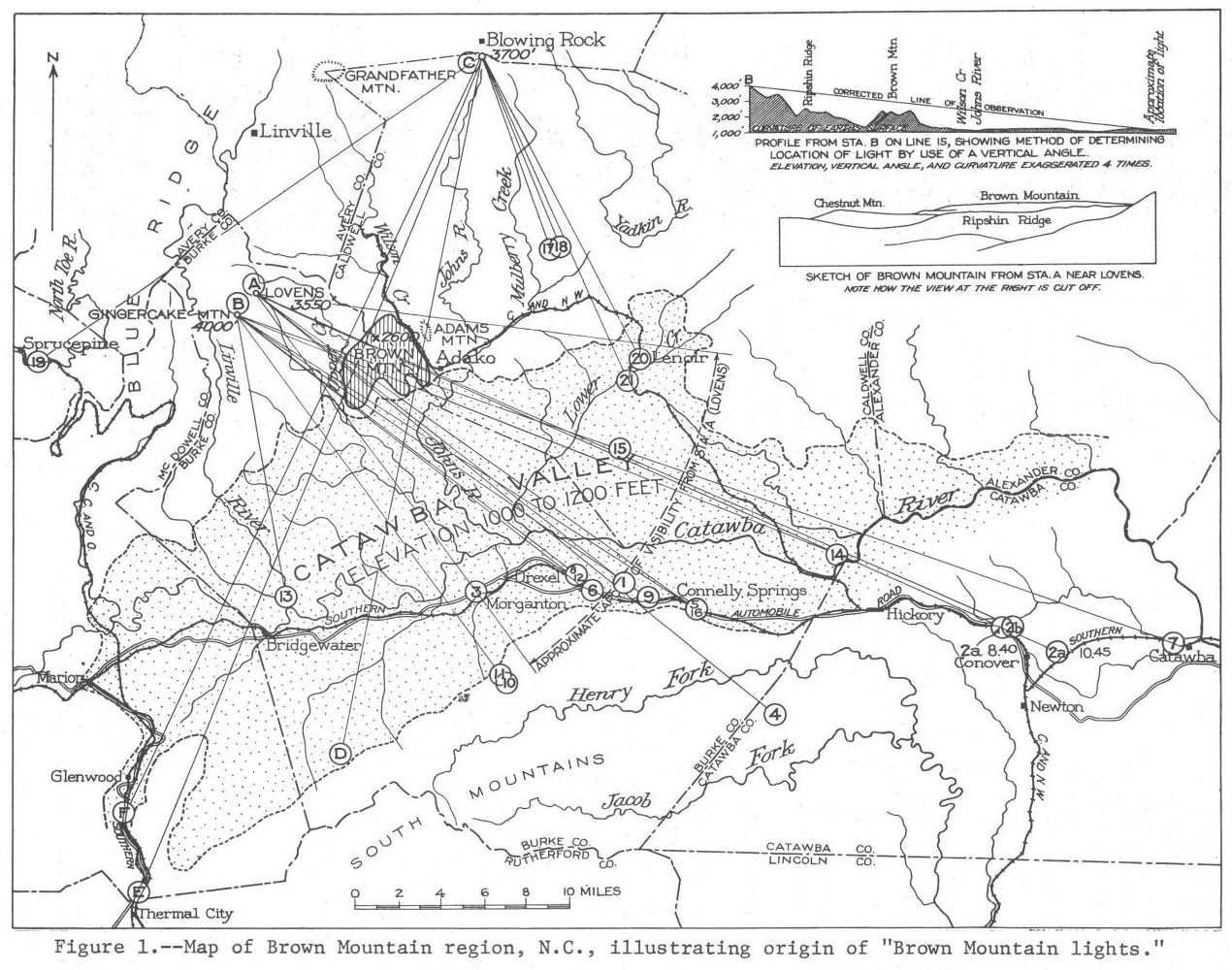
The setting that matters is the surrounding landscape. The report’s map shows the Catawba Valley east of Marion as a basin ringed by higher country, with the Blue Ridge on the north, and with towns, roads and railroads scattered through it.[1] The lights are seen from places such as the hotel at Cold Spring (Loven’s), Gingercake Mountain and Blowing Rock, all of which look across Brown Mountain to that basin.
The first report, 1913
According to Mansfield, the first published account was a dispatch from Linville Falls to the Charlotte Daily Observer, dated September 23, 1913. It credited the discovery to members of the Morganton Fishing Club, who had seen the light “more than two years ago” but were “laughed at and accused of seeing things at night.” The dispatch described a light that rose to the southeast “just over the lower slope of Brown Mountain,” first at about 7:30 p.m. and again at 10 o’clock. In the newspaper’s words, it “looks much like a toy fire balloon, a distinct ball, with no atmosphere about it,” much smaller than the full moon, much larger than any star, and very red; it rose, wavered and went out in less than a minute.[1]
Mansfield did not take that date at face value. He noted that the club members seem to have first seen it in 1908 or 1909, according to one of them, and he recorded other local testimony that points in different directions. A minister who served churches around the mountain from 1909 to 1912 wrote that he never once saw a light in those years, and an engineer who spent summers in those mountains said he never saw or heard of the lights until 1910. On the other hand, the editor of the Observer wrote that the light had puzzled people “since and before the days of the Civil War,” and a Morganton man said people used to come to Burke County sixty years earlier to see it.[1] In other words, the earliest evidence is a mix of recollection and assertion, and the idea of a deep history is, in the government report, one more claim to be weighed.
In October 1913, at the request of a congressman, a Geological Survey man named D. B. Sterrett went to the mountain. After a few days he concluded the lights were locomotive headlights seen from neighboring heights.[1]
The flood and the preacher
Sterrett’s answer did not hold for long. In the summer of 1916, a great flood swept down the Catawba valley, washing out bridges and railroad tracks and suspending train service “for several weeks” so that no trains came within 40 or 50 miles of Rattlesnake Knob. During that time the lights were reported to be seen as usual, which Mansfield acknowledged showed they “could not be ascribed solely to locomotive headlights.”[1] Locomotives were therefore not the whole answer. Mansfield noticed, though, that automobiles and their headlights were already in use in the region, and in his report that is a major part of his later explanation.
Other explanations competed. Mansfield summarized them one by one: will-o’-the-wisp, phosphorus, fox fire, radium emanations, a chemical reaction between hydrogen sulfide and lead oxide, illicit stills, St. Elmo’s fire and mirage, and dismissed most of them for specific reasons. For instance, he wrote that there were no marshy places on or about the mountain for marsh gas, that fox fire is “too feeble to be seen at a distance of several miles,” and that a rumored piece of radium ore “was never so identified by actual tests” and the specimen had been lost.[1] Late in 1919 the question reached the Smithsonian and was passed to the Weather Bureau, where a scientist concluded the light was an electrical discharge like the “Andes light” of South America; Mansfield noted that neither the Weather Bureau nor the National Geographic Society, which published a bulletin repeating that idea, had sent anyone to the mountain.[1]
The 1922 survey, step by step
What distinguishes Mansfield’s work is method. He and his local helpers set up a 15-inch plane table, which is a map fastened to a leveled board, with a telescopic alidade (a sighting ruler), dip-needle and pocket compasses, a barometer, a field glass and a camera. At each station the observer first located himself on a topographic map during the day by sighting known landmarks. At night, when a light appeared, he sighted it with the alidade, drew the line of sight on the map, measured the vertical angle and noted the time.[1]
He occupied three stations: one near Loven’s Hotel at Cold Spring, one on the east slope of Gingercake Mountain and one at Blowing Rock. Two nights spent on Brown Mountain itself were too unfavorable to set up a station there. Afterward he plotted every line on the map, drew profiles along the lines of sight, corrected for the curvature of the earth and for refraction, and checked railroad registers and train schedules from station agents across the region.[1]
The result is the map reproduced above. Mansfield noted that the stations were 1,000 to 1,500 feet higher than the summit of Brown Mountain, so that lines of sight to the lights passed several hundred feet above the top. This explains why the lights appear over the mountain: anything beyond the ridge, along that line of sight, seems to sit on top of it.[1] It also means that the viewer has no way to judge the distance of what he sees. Mansfield made the same point about the eye generally: “The eye is easily deceived at night as to the stability or motion of an object.” Two observers with him, he wrote, thought they saw a light move when it was actually motionless in the telescope.[1]
What was explained, and what wasn’t
Of the 23 lights Mansfield recorded by instrument, he reported that seven “proved to originate from locomotive headlights,” and an eighth was probably of similar origin, though the data were insufficient to establish it. Only one of the seven was known to be a locomotive headlight at the time of observation; the other six were identified only after the lines had been plotted and train schedules checked days later.[1] That detail matters. It shows a locomotive light, seen from that distance, was indistinguishable from the others in the moment. Mansfield described it as having no visible motion and no beam or rays, and he quoted a local woman as saying such lights look “as much alike as so many peas in a pod.”[1] He also pointed out that automobile headlights on the many roads of the valley would be visible from Blowing Rock over Brown Mountain.[1]
His proposed mechanism is atmospheric. He argued that after sunset, cool air creeps down tributary valleys into the Catawba basin from different sources at different temperatures, making the air unstable and changing its density, and so its refractive power, through the evening. Lights viewed through such air at low angles (less than 3 degrees even from 3,500- or 4,000-foot stations) flare and diminish, and mist and dust give them the reddish and yellowish tint observers describe. He noted that the light is most active in a clearing spell after rain, as many observers had reported, and that when mist is very dense it is hidden.[1]
His conclusion was blunt: “There is no geologic basis for the idea that the lights seen are natural wonders of any sort.” He added that the lights he saw were “a fair average display of the so-called Brown Mountain light,” and that they had nothing in common with the Andes light or with St. Elmo’s fire.[1]
Reading Appalachian folklore
The Brown Mountain Lights attracted legends almost at once, and the legends are worth reading, as long as they are read as legends. A few habits help, and they apply across the region’s stories, from the Wampus Cat of East Tennessee to the Mothman of Point Pleasant, West Virginia, to the Stingy Jack tale behind the jack-o’-lantern.
- Ask when the story first appears in print. Mansfield’s own survey of Brown Mountain testimony shows how claims of great age sit beside people who say they never heard of the lights before 1910.[1] Popular versions include a battle with torch-bearing women searching for the men who did not return, and a lost planter whose enslaved man searched with a lantern. They are often credited to older tradition, but they do not appear in the sources cited on this page; if you meet one, ask for the earliest citation.
- Separate the report from the explanation. A witness who describes a red ball that rose and wavered is giving evidence about what was seen. A story about whose ghost it is supplies meaning rather than evidence. Both belong in the record, in separate columns.
- Notice what the stories have in common. The popular versions, a searcher with a lantern looking for someone who did not come home, say less about the light than about the people who told them. A legend explains how a light feels. It does not say what it is.
- Treat dramatized retellings as retellings. Books, songs and videos (including ours) often dramatize reported accounts for effect. Check what is a quotation and what is a performance.
The Forgotten Frontier Outfitters channel has told several of these stories as fireside episodes, including the Wampus Cat of East Tennessee, Stingy Jack and the Mothman of Point Pleasant. They are presented as folklore, and they are labeled where the visuals and voices are AI-assisted.
Watch the fireside episodes
Wampus Cat Legend: Tennessee's Half-Woman, Half-Cat Cryptid
Stingy Jack: Jack-o'-Lantern Origin Story | After Dark on the Ridge
Mothman of Point Pleasant: It Kept Up at 100 MPH | 1966 Legend
How to research it yourself
- Read Mansfield’s report in full. It is short, readable and free from the U.S. Geological Survey. Pay attention to the testimony sections as well as the conclusions.[1]
- Find the newspapers. DigitalNC hosts historic North Carolina newspapers, and the State Archives of North Carolina can point you to local records and family papers.[2, 3]
- For the folklore, look for collectors. The Library of Congress American Folklife Center holds field recordings and collections from the Southern Appalachians.[4] Note who collected a story, where and when.
- Keep two columns. One for what people reported seeing, one for what they believed it was.
If you go looking
People commonly go to the Brown Mountain Overlook on North Carolina Highway 181, or to Wiseman’s View on the rim of the Linville Gorge. Conditions change from night to night, and Mansfield’s report suggests that clear air after rain is when the lights are most active.[1] Check current road and overlook conditions with local authorities before you go, dress warmly, stay behind the rails and pack out your trash. The gorge is steep, and the area is dark.
Watch the companion episode
Brown Mountain Lights, NC 1922: 23 Lights, 1 Survey | Case File 01 is on the Forgotten Frontier Outfitters YouTube channel. It covers the same subject as a story; this guide is the sources behind it.
From our own shop: Forgotten Frontier Outfitters makes original frontier-and-folklore apparel and gifts. If you like this kind of story, see our strange and unusual designs and our cryptid and Appalachian folklore designs. These are links to our own store, not third-party affiliate links; see the disclosure.
Further reading
- George R. Mansfield, “Origin of the Brown Mountain Light in North Carolina” (USGS Circular 646), free at pubs.usgs.gov: the primary source for everything in the first half of this guide.
Sources
Numbered in order of first citation. Links open the original or the library record.
- George Rogers Mansfield, “Origin of the Brown Mountain Light in North Carolina,” U.S. Geological Survey Press Notice 14328 (1922), reissued as USGS Circular 646 (1971). Full text: pubs.usgs.gov/circ/1971/0646/report.pdf. U.S. government work.
- DigitalNC, North Carolina Digital Heritage Center, historic newspapers: newspapers.digitalnc.org.
- State Archives of North Carolina, North Carolina Department of Natural and Cultural Resources: archives.ncdcr.gov.
- Library of Congress, American Folklife Center: loc.gov/folklife.